



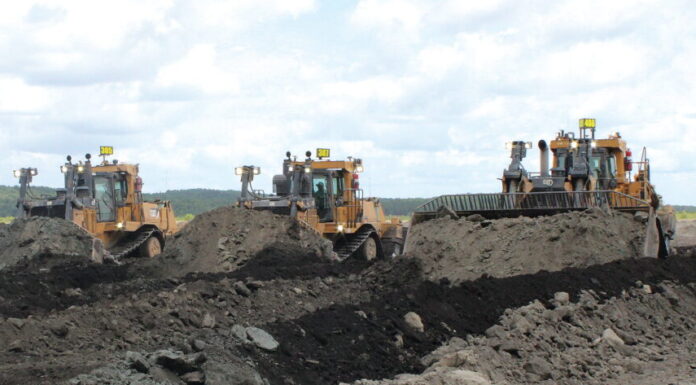
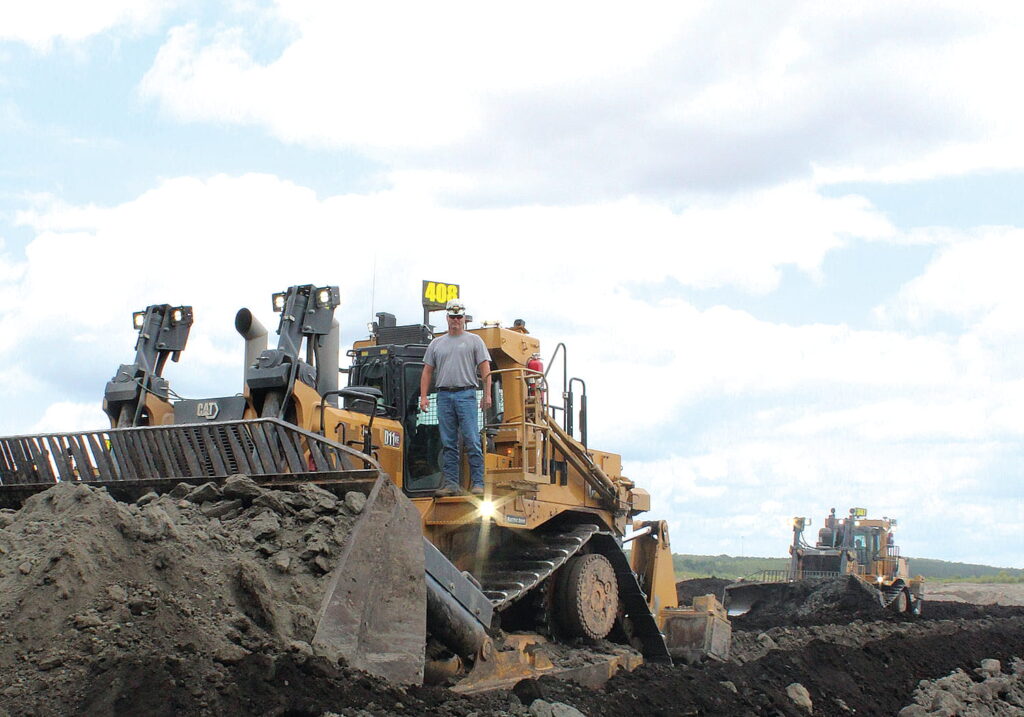
The field follow at the Red Hills mine provided a great opportunity to compare the Cat D11 XE side-by-side with mechanical drive dozers. (Photo: Steve Fiscor)
The new electric drive machine offers fuel economy and improved operator control, while reducing wear and tear on the engine
By Steve Fiscor, Editor-in-Chief
A coal mine operating among the pines in northern Mississippi has been testing a new electric drive model of the Cat D11 dozer. Participating in what Caterpillar refers to as a field follow for the Cat D11 XE, mine management, the operators and the local dealer say they are impressed with the new machine. The mine may not want to return the machine.
The Red Hills mine near Ackerman, Miss., produces 2.5-3.2 million tons per year of lignite. North American Coal, a NACCO Natural Resources company, owns the mine and the equipment, and supplies the coal to a nearby power plant, which is owned by an affiliate of Southern Company.
The horizon in which Red Hills operates has six relatively thin seams. The current stripping ratio is about 11:1. The top two seams are uncovered using trucks and shovels. The next two seams are uncovered by dozer push using the mine’s four Cat D11 dozers. The interburden between the bottom two seams varies from 30 to 40 ft and the mine uses a Marion 8200 dragline (82 yd3) operating in a spoil-side configuration to uncover the bottom two seams.
The loading equipment consists of a P&H 2800 electric shovel (42 yd3), two Cat 6040 excavators operating as front shovels, one Cat 6040 operating as a hoe, a Cat 5230 operating as a shovel, and a Komatsu PC2000 operating as a hoe. The haulage fleet consists of 14 Cat 789 haul trucks and four Cat 785 haul trucks equipped with coal bodies. To mine the coal from all six seams, which vary from 2- to 4-ft thick, Red Hills uses two Wirtgen 4200 surface miners. The mine has enough reserves to operate for another 20 years or more.
As the active pit advances, the mine reclaims the land behind it. The dozers at Red Hills play a vital role in active mining and reclamation activities, explained Matt Jones, president and general manager for the Red Hills mine. “We are currently working on a multi-year project to complete final reclaim of an older pit and create a lake for recreational use,” he said. “It will serve as sedimentation control for the new mining area for a few years. The dozers are knocking down the final pit spoils, filling in ramps and re-spreading oxidized material, in addition to normal mining operations.”
The dozing activity at Red Hills also made it an ideal candidate for the field follow testing for the Cat D11 XE. Not only would the machine see valuable time in the dirt, but Red Hills and Caterpillar could see firsthand how the machine performs next to traditional mechanical drive tractors operating in the same conditions.
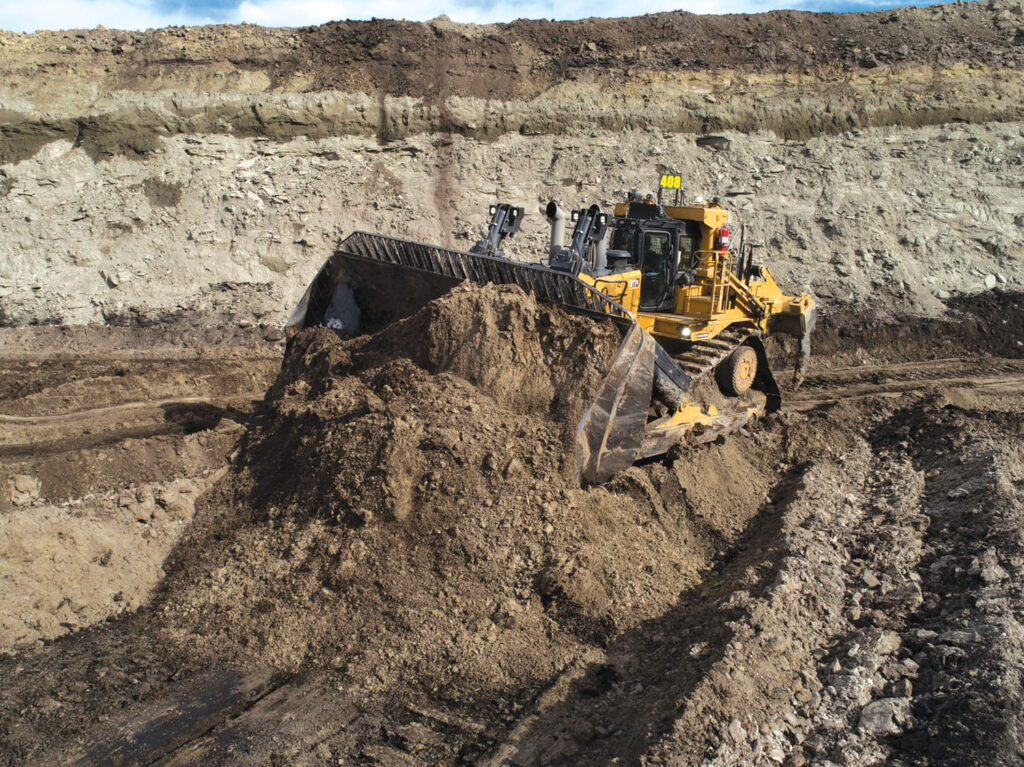
With power on both sides versus pulling a steering clutch and dropping power, the operators claim the D11 XE can turn on a dime. (Photo: Caterpillar)
The Electric Drive Design
The Cat D11 dozer is celebrating its 40th anniversary in 2026. Caterpillar developed the machine in 1986 to meet demand for a larger, more powerful dozer. The first model, the Cat D11N, set new standards for power and efficiency. With each new D11 model released (D11R, D11T and D11), efficiency continued to climb. Caterpillar unveiled its plans for the D11 XE at MINExpo 2021 and it is expected to be 25% more efficient than the D11 and 40% more efficient than the D11N.
With the powertrain for the D11 XE, a generator sits directly behind the Cat C32B diesel engine. The transmission that sat on the back of the tractor case has been replaced by an inverter. Each side has an electric motor, brake and final drive.
“The drive motors are bolted to the final drives, which have been redesigned,” said Tim Bowen, service operations manager for Thompson Machinery, the Cat dealer serving northern Mississippi and Tennessee. “The D11 XE has no steering clutches. The brakes are the same. The only remaining mechanical aspect of the powertrain is the final drives themselves. They are slightly different. They still have the double planetaries on the outside and they use the same sprocket segments, but there is another planetary on the inside now that splines to the drive motors to transfer power.”
Caterpillar designed the D11 XE powertrain for 20% longer life (18,000 hours vs 15,000 hours) on the electric drive components, engine, final drives and hydraulics. The engine has a lower high-idle speed, and the D11 XE has increased cooling capacity versus the mechanical drive D11. The torque converter, transmission and bevel gear have been eliminated.
In addition to a 30% lower cost per hour, the machine should require one less rebuild than the D11 over the course of its life. Caterpillar placed six D11 XE’s in the field, including the machine operating at the Red Hills mine.
Dozing Effectively
The Red Hills mine tries to keep three or four machines working in the active mine dozer-push area. For them, that amounts to two Cat D11Ts, a D11R and the D11 XE. Some are equipped with carry blades. “You really can’t be productive with anything smaller than a D11,” said Butch Davis, operations manager, Red Hills mine.
“When we started the field follow program for the D11 XE, there was a little reluctancy in the very beginning,” Davis said. “Some of the more experienced operators were not ready to make that leap into something new, but now they are just as satisfied as they were when they got on the first D11.”
The hesitation is understandable. Aside from being a brand new machine, the engine runs at lower speeds and loads. There are some new tricks to operating it (compared to the D11), especially when it comes to steering the machine. There’s a pedal in the cab for “feathering” the electric drive where the decelerator used to be.
“We tend to do a lot of field follows here, not just for machines, but on modifications to machines, different pins, rollers, etc.” Jones said. “And this one, it was a particularly good fit because our production dozer fleet is typically four D11s pushing side-by-side in a slot dozing configuration. Caterpillar could not have found a better side-by-side comparison with two other models of D11. It’s a perfect data gathering opportunity for Caterpillar.”
When asked about the Cat D11 XE’s best attributes, the Red Hills team said better fuel burn immediately in unison. “We have not completed an official study, but we know the fuel burn has improved significantly,” Davis said.
“Operator comfort is important and the operators like the cabin,” Davis said.
The XE is not as jerky, Davis explained, turning the dozer is a smoother transition because it has power on both sides versus “pulling a steering clutch and dropping power.” That helps production wise when they cut the highwall. They are able to power turn versus a negative force turn.
With constant power to both tracks, the difference is night and day as far as how smooth it operates in tight spaces, Bowen said.
“When you’re pushing in a slot, you tend to bite in on one side a little more than the other,” Davis said. “The tendency is for the machine to be drawn into
the highwall. The operators can force their way out of that a little easier. The machine has a smoother overall operation. We also have had positive comments as far as the balance of the electric drive being better than the mechanical drive machines.”
The D11 XE has a split gear. In addition to a first, second and third gear, it has a 1.5 gear. The 1.5 is a comfortable speed, and the operators can also drop down if the digging conditions change.
The operators will all tell you that they are not getting fuel nearly as often as they used to, Jones said. Red Hills has four crews running two 12-hr shifts per day, 24/7, and the dozers might be able to go the entire 12-hour shift without refueling, whereas the mechanical drives would refuel at some point during the shift.
With the engine operating at a lower RPM, the fuel economy improves as does the time between rebuilds for the engine.
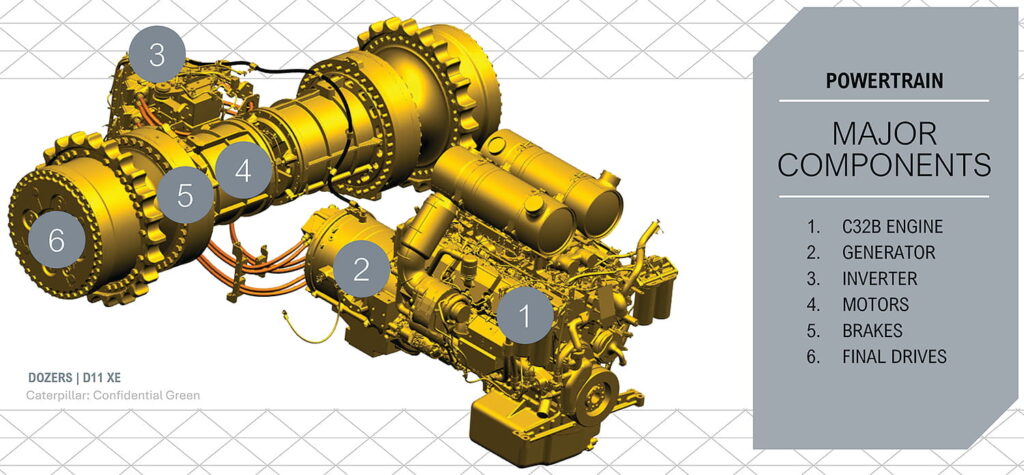
The transmission on the D11 XE has been replaced by an inverter and a generator. Each side of the dozer has an electric motor, brake and final drive. (Source: Caterpillar)
Fewer Moving Parts, Less Maintenance
A transmission has a tremendous number of moving parts. That has been eliminated along with the torque converter and bevel gear. The Cat D11 XE has 60% fewer moving parts and 85% common parts with the D11.
This machine is a field follow, so Thompson manages a good portion of the maintenance. “We have performed a lot of the updates,” Bowen said. “The Red Hills maintenance crew does the PMs, and they replace wear items like cutting edges. Lately, it’s been a few software updates and the Cat engineers are usually on site for that, but we have been through a couple of undercarriages already.” The undercarriages are the same for all four dozers.
Jeff O’Neal, a mechanic with Thompson, takes fluid samples from the D11 XE every 250 hours. “Mechanically, it seems to be holding up good,” he said. “Working on this machine is a lot easier. I can have the generator out of this dozer in probably 2.5-3 hours. The torque converter on a regular D11 requires five or six hours. You have to pull the transmission, and move cylinders and lines to be able to drop the H link down on a ripper. On the D11 XE, you can get under the dozer and drop the generator out, pull the finals and the motors out, and you don’t have to fool with anything on the back of the tractor.”
The recondition interval for the final drives, transmission, torque converter and engine on the mechanical powertrain was 15,000 hours. The Red Hills machine is approaching 11,000 hours, and Caterpillar is projecting 18,000 hours for the drive motors and generators.
“One would think that when you are loading that blade on a mechanical drive from idle to a high RPM, the machine would run hotter,” Davis said. “The D11 XE’s engine runs at a constant speed, but lower RPM than the Cat D11T’s, which equates to less wear and tear on the engine, and more consistent operation.”
Red Hills dozer operator Mark Williamson (above) really enjoys operating the Cat D11 XE. (Photo: Steve Fiscor)
Operators Are Happy With the D11 XE
During E&MJ’s visit to the Red Hills mine, dozer operator Mark Williamson, stopped the machine for a few minutes and shared his thoughts. He said he likes how the machine handles and the comfortable cab. “With the XE, I feel like Caterpillar has built the perfect machine,” he said. “There is more room in the cab for the operator. It makes working long hours a little nicer.” Williamson is a tall guy, and he said he can stretch out, get comfortable and do his work.
“This machine turns on a dime,” he said. “You are able to turn a lot easier than the older Cat D11s with thumb controls. They can’t turn as sharp.”
With a mechanically driven dozer, the operators would drop the clutch to stop the track in the direction they were turning. On the Cat D11 XE, if the operators want to turn left, they slow the left track and increase the speed on the right track. The turn is a much smoother transition, and the dozers can carry more material. It improves operator performance and productivity.
“This dozer is using 50 gallons per shift less than the other dozers,” Williamson said. “That’s a significant amount of savings over a year.”
If he had a choice, Williamson said he would rather run the Cat D11 XE. “This machine has 100 more horsepower in reverse,” he said. “You can do more with this dozer in the mud than the Cat D11Ts.” If you don’t have the experience, the Dll XE will make up the difference with the extra power and maneuver better in muddy digging conditions.
As far as the controls, Williamson said Caterpillar has swapped sides with a few controls, but it didn’t seem to bother him. “The idle up and down is on the left now, but the joysticks are still in the same place with the blade,” he said.
“This machine just operates more precisely,” Williamson said “It reacts instantaneously. With the older dozers, it would take a second to grab when you shifted gears. We would have to time them out to make an adjustment and maneuver.
“With long pushes, the half gears are extremely nice,” Williamson said. “Whenever we can, we try to use the 1.5 gear for long pushes just for speed purposes.
“Man, I’m so impressed with this machine,” he said. “It makes a world of difference for me as far as my job during the day.”
After operating a more manual machine, the operators can feel fatigue because they are fighting with the machine as they push the blade through a turn. The Cat D11 XE pushes a fully loaded blade through a turn easily and it’s not nearly as strenuous on the operator.
Based on what E&MJ observed at the Red Hills field follow, Caterpillar has made a significant improvement for a machine that was already considered highly productive. Mine management and the operators are happy with its performance. As far as major rebuilds, only time will tell, but logical thinking indicates that the Cat D11 XE will outperform the D11. The product launch is a great way to celebrate the 40th anniversary of the D11.
This article was previously published in the September 2026 edition of Coal Age.
The post Red Hills Mine Trials the Cat D11 XE appeared first on E & MJ.