




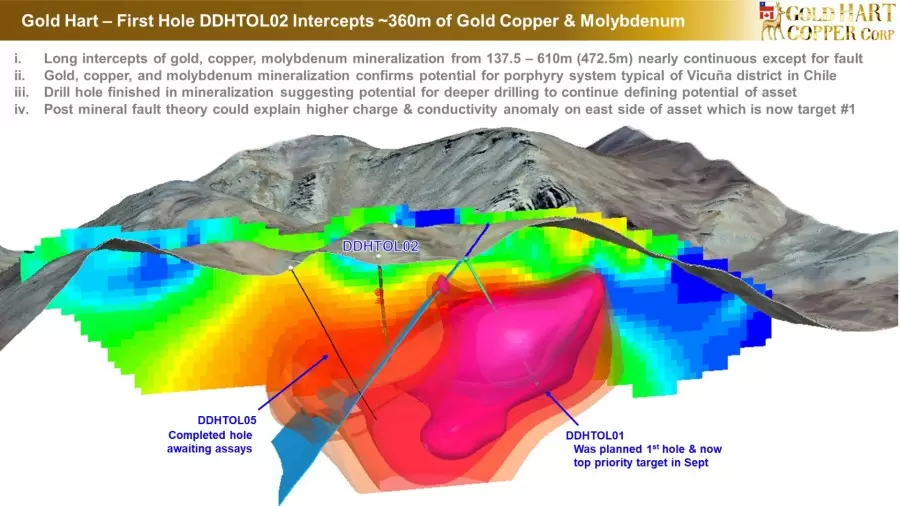
Gold Hart Copper Corp. (TSXV:HART) has released the results from the first diamond drill hole at its flagship Tolita gold-copper-molybdenum project, located in the Vicuña District of northern Chile. The company’s initial drill results confirm the presence of porphyry-style mineralization and mark the conclusion of the hole in mineralized rock, suggesting a potentially large mineralized system at depth.
Enrique Viter-Aldunate, Vicuña pioneer and Tolita discoverer commented in a press release: “I could not be happier with the first drill hole at Tolita, as 320m+ of 0.24-0.25g/t is highly indicative of a potentially very large gold system. I recall from my personal experience drilling Cerro Casale that the first several holes did not return such an extensive and continuous presence of gold, and of course that asset has now become the largest gold-copper deposit on the continent. In fact, from around 130m to the end of the hole at 610m (nearly 480m), it would appear that there is nearly consistent mineralization except for the 150m sterile zone which we now believe to be a major geological fault. This drill hole has also significantly advanced our geological understanding of the asset, as Dr. Professor Jose Frutos and I now both strongly believe that this fault may have caused the higher-chargeability and higher-conductivity anomaly to land closer to surface on the eastern side of the property, which could potentially host higher grades. I believe this first hole (DDHTOL02) should lay to rest any questions around whether or not Tolita has potential to be a porphyry, because the drill hole clearly proves we intercepted porphyry-style mineralization typical of the Vicuña. Like this first diamond drill hole, all historic RC holes were also drilled into the western side of Tolita; so the eastern side remains completely untested, and drilling the near-surface high-chargeability high-conductivity zone must be priority number one, as was our original plan with DDHTOL01. I am extremely excited about the future as Gold Hart advances further drilling particularly on the eastern side of the asset.”
Isaac Maresky, Co-founder & CEO of Gold Hart, also commented: “We are thrilled to have encountered such long intervals of gold, copper, and molybdenum particularly so early on in our first drill hole ever at Tolita. I am more excited than ever about the potential of Tolita and to continue the drill campaign in September. Now that we have been fortunate enough to return porphyry-style intercepts so early, with good correlation between geophysical anomalies and gold-copper-molybdenum, we can focus on honing in on the top-tier drill targets where we might find grades. Interestingly, the eastern side of the property – totally open and untested – is exactly where the chargeable geophysical anomaly is highest and also where the highest conductive zone overlaps as well.”
Drill Hole DDHTOL02: Intercepts 360 Meters of Mineralization
The first diamond drill hole, DDHTOL02, was drilled to a depth of 610 meters, intersecting porphyry-style mineralization consistent with geological models for the Vicuña District. Gold Hart reports that the hole encountered near-continuous gold, copper, and molybdenum mineralization beginning at approximately 137.5 meters downhole and continuing through to the end of the hole. The mineralized interval was interrupted by a 150-meter sterile zone interpreted to be associated with a major fault structure.
The company notes that the drill hole ended in mineralization, suggesting the system remains open at depth.
Pending Results from Second Drill Hole
Gold Hart’s initial 2025 drill program at Tolita consisted of approximately 1,200 meters. A second and final hole, DDHTOL05, has been completed, and results are expected to be announced in the coming two weeks. The company has not yet provided details on the depth or visual mineralization of this second hole.
Historical and Geological Context of Tolita
The Tolita property is located at the junction of the Maricunga Gold Belt and the emerging Vicuña Copper Belt, a region known for large-scale porphyry and epithermal deposits. First staked in 1993 by one of the geologists credited with early discoveries in the area, the project was originally recognized for its high surface grades of gold and copper.
Due to unfavorable commodity prices at the time — gold around $300/oz and copper under $1/lb — and limited investor interest in large-scale sulphide deposits, the planned eight-hole drill program was not completed. Only three holes were drilled, and the project remained largely untested at depth for nearly three decades.
Exploration Strategy and Land Position
Gold Hart Copper holds one of the largest independent land positions surrounding producing and major exploration-stage copper and gold projects in Chile. In addition to its holdings in the Vicuña District, the company recently acquired three new properties to the west, along the Paleocene-Eocene Belt near the Domeyko Fault — a zone that hosts some of Chile’s largest copper and gold operations.
These new properties include historical mines with surface mineralization and large-scale alteration and magnetic anomalies extending approximately 6 kilometers. The company’s technical team has indicated that these anomalies are under evaluation for future drill targeting.
Technical Team and Project Oversight
Gold Hart’s technical team includes senior geologists involved in some of Chile’s major discoveries. Among them is Dr. José Frutos, the country’s former Deputy Manager of the Geological Survey.
Several of Gold Hart’s current properties were staked in the 1990s by members of this team and remain under the company’s control with no royalty encumbrances.
Porphyry Targeting and Ongoing Campaign
The Tolita drill program is intended to test a large, preserved porphyry system with strong surface mineralization and geophysical anomalies. Gold Hart describes Tolita as one of the only untested, large-scale porphyry targets in the Vicuña District that has not undergone significant modern drilling despite early positive results.
In contrast to oxide-dominated deposits that received more attention in the 1990s, Tolita hosts a sulphide-dominant system, often less attractive to junior companies in past low commodity price cycles. Gold Hart has stated that, given the improved market environment for copper and gold, and the demand for long-life copper-gold assets, the project has become a focus of renewed exploration.
Gold Hart plans to release the assay results from DDHTOL05 in the near term. The company has not announced any additional drilling beyond this two-hole program but has indicated that the results will inform the next stage of exploration across the broader Tolita project area.
The post Gold Hart Copper (TSXV:HART) Reports 360-Meter Mineralized Intercept in First Diamond Drill Hole at Tolita Project in Chile’s Vicuña District appeared first on MiningFeeds.