




First Atlantic Nickel (TSXV: FAN; OTCQB: FANCF; FSE: P21) has announced a substantial expansion of its RPM Zone within the Atlantic Nickel Project, following new drill results that confirm increased width and scale of awaruite mineralization.
Highlights from the results are as follows:
- AN-25-07 Expands RPM Zone to 750 Meters in Width: The second hole of the Phase 2 drill program confirms a drilled width up to 750 meters wide of mineralization, with visibly disseminated awaruite grains observed throughout a 495-meter intersection.
- 400-Meter Step-Out Success: AN-25-07 was drilled on Line S2, a 400-meter step-out north from Line S1, demonstrating strong continuity of awaruite mineralization along strike.
- RPM Zone Now Measures 750 Meters Wide x 400 Meters Long: Every hole drilled at the RPM Zone has intersected large grain visibly disseminated awaruite, with mineralization now traced to depths of up to 495 meters downhole.
- Phase 2 Expansion Targeting 1 km+ Strike Length: Holes AN-25-08 and AN-25-09, drilled on Line S3, have extended the tested north-south strike length to 800 meters. The Phase 2 program is designed to test beyond 1 kilometer.
- Consistent Metallurgical Performance: To date, drilling at the RPM Zone has returned magnetically recoverable nickel averaging 1.38% in magnetic concentrate, with a mass pull of 9.08%. This results in an average DTR nickel grade of 0.12% and overall recovery of 51.59% from an average starting grade of 0.24% over 1,763 meters of continuously sampled core.
- Multiple Updates Expected: The Company anticipates providing additional updates on Phase 2 drilling and other project developments in the coming weeks.
As noted by the United States Geological Survey (USGS) in 2012: “The development of awaruite deposits in other parts of Canada may help alleviate any prolonged shortage of nickel concentrate. Awaruite, a natural iron-nickel alloy, is much easier to concentrate than pentlandite, the principal sulfide of nickel.”
“We congratulate our geological team on the breakthrough discovery at the RPM Zone” stated Adrian Smith, CEO of First Atlantic Nickel. “Prior operators conducting exploration at the Pipestone Ophiolite Complex missed the awaruite mineralization in the southern parts of the property, where our team’s systematic approach and unique experience recognized both the geological controls and the distinction between surface expressions and underlying mineralization. Thanks to Newfoundland’s streamlined permitting process, we have advanced from discovery to Phase 2 drilling significantly faster than would have been possible in many other jurisdictions. Our geological team’s expertise has been instrumental in understanding this 30-kilometer awaruite system – a rare nickel alloy that offers the potential to provide a nickel source while eliminating the energy consumption, environmental impacts, and capacity constraints associated with conventional smelting, roasting and acid leaching processes of nickel sulfide or laterite ores.”
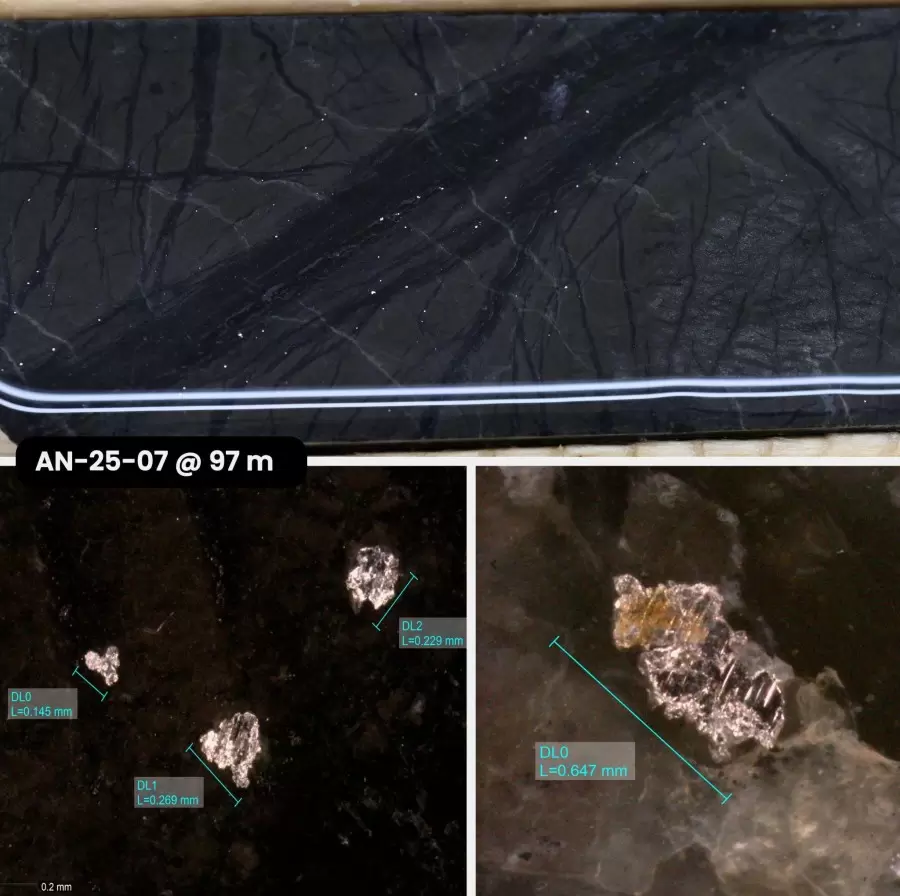
The most recent drill hole from the company’s ongoing Phase 2 drill program, designated AN-25-07, intersected 495 meters of visibly disseminated awaruite—a naturally occurring nickel-iron-cobalt alloy. The results extend the known mineralized zone to 750 meters in width, a 50% increase from the previously established 500-meter width during Phase 1 drilling.
The RPM Zone is part of First Atlantic’s 100%-owned Atlantic Nickel Project, a 30-kilometer district-scale initiative located in central Newfoundland. AN-25-07 was drilled approximately 400 meters north of the original discovery holes and ended in mineralization, indicating the potential for further lateral and depth extensions.
Details of the Drill Hole and Mineralization
Drill hole AN-25-07 was collared on survey line S2, north of the initial discovery on line S1. The hole intersected serpentinized peridotite hosting disseminated awaruite over a 495-meter section. Geological logging and microscope analysis confirmed the presence of awaruite grains throughout the core, with grain sizes visually consistent with those identified in previous holes.
Photographs of the core at multiple depths (97m, 245m, and 354m) display visibly disseminated awaruite grains, ranging in size up to 647 microns. These observations further support the continuity of mineralization within the RPM Zone and the geological consistency of the host rock.
The drill core also supports the theory that the mineralized zone extends westward and to depth, as the hole terminated within mineralized rock.
Phase 2 Drilling Progress
The Phase 2 program aims to test both the north-south strike and the width of the mineralized body. Following the success of AN-25-07, two additional drill holes, AN-25-08 and AN-25-09, have been completed on line S3. With these additions, the company has now tested over 800 meters of north-south strike length within the RPM Zone.
Together, these drill holes support the presence of a potentially continuous zone of awaruite mineralization over more than one kilometer. The expansion enhances the geological model for the RPM Zone and supports the idea of a bulk-tonnage nickel target.
RPM Zone: Overview and Geological Context
The RPM Zone lies 10 kilometers south of the Super Gulp Zone and 26 kilometers south of the historical Atlantic Lake Zone. It represents a new discovery within the Pipestone Ophiolite Complex, a 30-kilometer-long belt of ultramafic rocks considered prospective for nickel mineralization.
The RPM Zone has grown rapidly in scale since its initial discovery and now measures approximately 750 meters wide by 400 meters long. The mineralization remains open in all directions, with no current geological constraints on its full extent.
Early metallurgical testing, including Davis Tube Recovery (DTR), has returned an average nickel grade of 1.38% in magnetic concentrate across all RPM drill holes. This supports the suitability of awaruite for magnetic separation, a process that does not require smelting, roasting, or acid leaching.
Mineralogical and Environmental Considerations
Awaruite (Ni₃Fe) is a sulfur-free nickel-iron-cobalt alloy that occurs in metallic form, allowing it to bypass traditional nickel processing methods. Unlike sulfide and laterite ores, which often require energy-intensive processes and present environmental challenges, awaruite can be processed through magnetic separation alone.
This characteristic avoids the need for smelting capacity—currently a bottleneck in the North American nickel supply chain—and eliminates risks such as acid mine drainage (AMD), which often complicate the permitting of sulfide ore projects.
The average nickel grade of awaruite (~76%) significantly exceeds that of common sulfide minerals like pentlandite, which typically contain around 25% nickel. This high-grade potential, combined with its favorable processing profile, continues to position awaruite as a strategic mineral for clean energy and battery metals supply chains.
Ongoing Exploration Across Pipestone Ophiolite Complex
In parallel with drilling at RPM, Phase 2 includes district-scale prospecting across the broader 30-kilometer Pipestone Ophiolite Complex. Numerous surface rock samples containing visible awaruite have been collected and are undergoing both assay and DTR metallurgical testing.
This regional work is intended to identify additional mineralized zones beyond RPM and evaluate the broader potential of the Atlantic Nickel Project area.
Next Steps and Anticipated Updates
With three drill holes completed in Phase 2 and visible awaruite confirmed over a wide area, First Atlantic Nickel expects to provide additional updates in the coming weeks. Ongoing drill results, surface sampling data, and metallurgical testing are expected to further refine the understanding of the RPM Zone and the overall potential of the Atlantic Nickel Project.
No resource estimate has yet been published for the RPM Zone, and further drilling will be required to define the scale and grade of mineralization before any economic assessments can be made.
The post First Atlantic Nickel (TSXV:FAN) Reports Significant Expansion of RPM Zone in Newfoundland Drill Program appeared first on MiningFeeds.