




By Amy Gower and Ben Kelson
Copper is being pulled into the USA and China simultaneously, tightening availability elsewhere. The market is awaiting a U.S. decision on whether to put in place a 15% refined copper import tariff starting January 1, 2027, potentially rising to 30% in 2028. Pre-buying ahead of potential tariffs has driven an estimated 335,000 metric tons (mt) of U.S. over importing year-to-date, equivalent to roughly 2.3% of global
demand on an annualized basis and more than the estimate of data center copper consumption this year.
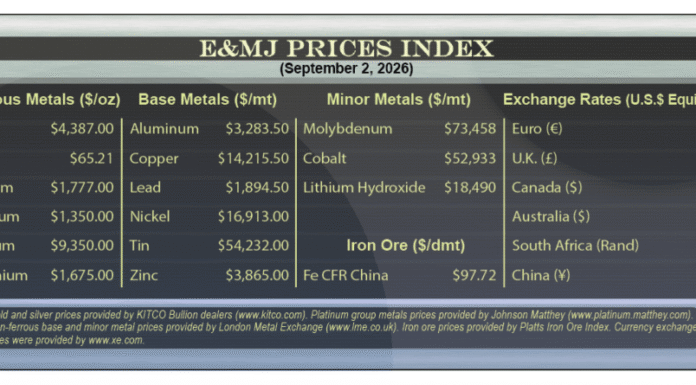
China is competing for the same units too. Refined imports rebounded 10% year-on-year (YoY) in June despite elevated prices and the Yangshan premium continued rising to $115/mt in July. However, the import premium has subsequently eased from this level amid an LME price of more than $14,000/mt, suggesting some Chinese consumer reluctance to continue engaging at this price level.
Supply remains challenged, on both concentrate and scrap. The International Copper Study Group reported global mine production fell 1.9% in
January-May 2026, with concentrate output down 3.4% offsetting SX/EW growth of 3.5%. We model 0% mine supply growth for 2026, implying some improvement in H2 2026. Q2 2026 production results were largely below consensus, while July’s atmospheric river in Chile brought further disruption and El Niño poses risks into early 2027.
The recent ban on copper concentrate exports from the Democratic Republic of Congo (DRC) adds an additional source of tightness. However, the impact may not be as significant as headlines suggest, with the DRC’s copper exports largely in the form of cathode or blister combined with expectations of lower concentrate exports in 2026 following the ramp up of the Kamoa smelter.
Scrap is the second constraint: China’s clampdown on circular and reverse invoicing has reduced compliant scrap availability, pushing secondary fabricators towards refined metal while tightening smelter feed. Refined output growth has decelerated accordingly.
U.S. imports should fall YoY in 2027 regardless of the Section 232 outcome as stockpiling unwinds, removing the ~2.3% of global demand currently being diverted and allowing ex-U.S. markets to loosen. Mine supply should also recover modestly from a low base. However, structural concentrate tightness, persistent scrap constraints and demand growth from data centers, grid and AI related infrastructure should keep the market in deficit, arguing for lower average prices relative to 2026, rather than a meaningful move lower. We forecast LME $14,250/mt and COMEX $6.85/lb for Q4 2026, moderating to a 2027 average of LME $12,900/mt (from $13,471/mt in 2026e) and COMEX $6.23/lb, with Q4 2027 at $12,500/mt and $6.01/lb.
Amy Gower is a commodities strategist for Morgan Stanley Research and Ben Kelson is a research associate for Morgan Stanley Research. This timely market analysis article was part of much larger piece, Copper Mining Transmission in Chile and Peru, published on August 17, 2026, by Morgan Stanley Research.
The post Copper: Tariffs, Stockpiling, and Supply Tightness appeared first on E & MJ.