


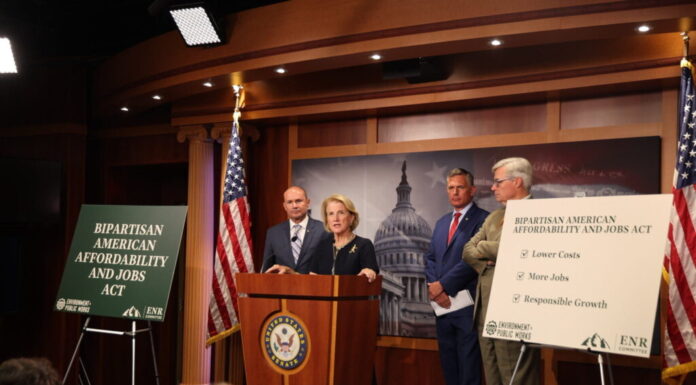
Senators Shelley Moore Capito and Sheldon Whitehouse, alongside ENR Chairman Mike Lee and Martin Heinrich, have introduced the Bipartisan American Affordability and Jobs Act of 2026. (Photo: U.S. Senate EPW Committee)
U.S. Senators Martin Heinrich (D-N.M.), Mike Lee (R-Utah), Shelley Moore Capito (R-W.Va.) and Sheldon Whitehouse (D-R.I.) introduced the Bipartisan American Affordability and Jobs Act of 2026 in the Senate on September 30. The bill is intended to reform the federal environmental review and permitting process.
The 417-page bill aims to streamline the often-lengthy federal permitting process to speed project buildout, ordering fair treatment of all energy resources when issuing new permits for projects now and under future legislation, regardless of the resource. According to the U.S. Senate Energy and Natural Resources Committee, the Bipartisan American Affordability and Jobs Act will provide certainty that permitted energy and infrastructure projects will retain their permits absent extraordinary circumstances, violations of law, or court order, as well as targeted reforms for various energy projects.
Mining organizations have argued for years that lengthy environmental reviews, overlapping regulatory requirements and litigation can severely delay mining projects, creating uncertainty for companies considering major investments. By establishing clearer timelines and streamlining parts of the permitting process, the bill could make it easier for companies to develop domestic mineral resources.
“America is entering a new era of energy demand. We have an enormous opportunity to build big things again to meet this moment – to build more generation, expand our grid, create more jobs, lower energy costs, and make sure we have the energy we need to compete. It should not take decades to build the infrastructure our country needs,” said Heinrich in a statement.
Heinrich emphasized that getting to a “yes” or “no” on permitting faster does not mean eliminating environmental protections, Tribal consultation, or the ability to challenge projects in court. This deal would keep important safeguards in place, while creating clear timelines and rules for permitting projects, including a two-year deadline for Environmental Impact Statement reviews and a one-year deadline for Environmental Assessment reviews, with consequences for agencies that miss those deadlines.
The bill would also establish a new National Historic Preservation Act (NHPA) consultation process that runs alongside National Environmental Policy Act (NEPA) reviews with a defined time limit, securing a statutory role for Tribes in determining how projects affect historic and cultural resources and protecting Tribes’ rights to formally consult. It would limit the types of impacts projects are required to mitigate, set clear limitations on when and how a project may be legally challenged, and set a 150-day deadline for legal challenges under the Clean Water Act (CWA), Endangered Species Act (ESA), NEPA and NHPA, along with several more limitations aimed at tightening the process.
“For far too long, our broken and outdated federal environmental review and permitting processes have stood in the way of energy reliability, secure jobs, modern infrastructure and economic growth. The bipartisan reforms we secured in this deal will transform our nation’s ability to power our economy and fuel future growth, while continuing to protect the land, water, and wildlife we all cherish,” said Capito.
The Bipartisan American Affordability and Jobs Act was introduced just before the chamber is set to leave until after November’s midterm election. The bill is now expected to be a top priority in the Senate when they return. If passed, the bill will still have to pass through the House and eventually on to the president’s desk.
The post Bipartisan Mining Reform Bill Introduced in Senate appeared first on E & MJ.