

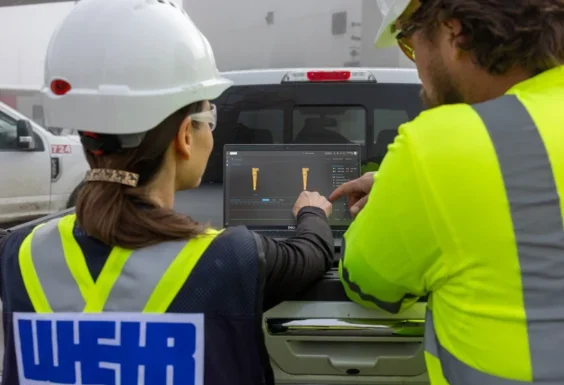
Weir is a lead proponent of the use of artificial intelligence in the processing plant, with its NEXT Intelligent Solutions platform continuously evolving in line with machine-learning capabilities.
In its Expert Q&A Series on AI and Digital Twins, Kenneth Ulrich, Head of Data and AI, answered some questions on the possibilities of AI in the mineral processing plant.
Weir: Processing plants are constantly managing inherent variability – fluctuations in feed, ore grades, rock hardness, mineralogy, etc. So, where do you think there is the most potential for AI to be deployed to help manage this?
KU: Typically, operators run their equipment conservatively because variance is expensive. When they find settings that work there’s understandably a reluctance to make any changes that might risk that. There is a natural asymmetry – if you trip the mill, that’s worse than underloading it. So, there are margins everywhere and AI can be deployed to safely and effectively close those margins.
For example, Weir’s NEXT Intelligent Solutions have been focused on finding improvements in comminution, particularly by modelling HPGRs and improving classification in the mill circuit by modelling ball mills, hydrocyclones and pumps. There is obviously difference across these applications; for instance, HPGRs react much more slowly to changes in the feed, whereas the mill circuit has to deal with changes much more regularly.
However, in each case, Weir takes a similar approach. We use models that are academically-derived, physical, metallurgical models of processes we’re trying to simulate. By constantly recalibrating these models, we can detect subtle changes in the process, such as shifts in ore hardness or moisture, and provide recommendations.
Weir: How are AI models trained?
KU: The customers’ data is used to optimise the performance of the equipment. There is a lot of variability in every process – change in ore feeds, fluctuations in grades, etc – which means that the AI model needs to be trained with site-specific data. And this is an on-going process, whereby the models are continually recalibrating in order to adapt to these constant changes.
For instance, the HPGR operator sets the pressure and the roller speed and they know the distance between the mid points of the rollers. It’s harder to measure the distance between the two roller surfaces because they wear. This is something that needs to be soft sensed. A soft sensor creates a new, hardware-sensor-like signal, but this signal is produced by a software sensor instead of a hardware sensor.
If you’re in the business of optimising mining equipment you’re in the business of modelling wear. There are a suite of benefits Weir’s NEXT Intelligent Solutions can deliver – predictive maintenance, process optimisation, automated spare parts inventory management system, just to mention a few options – based on the customers requirements, but, at the end of the day, you are always going to have to understand the way the behaviour of the equipment is altered with wear.
Again, to use a HPGR as an example, there are things you can measure, like the particle size distribution (PSD) of the discharge, and then for the things that you can’t measure directly, like ore hardness or grindability, you can use the available data to make inferences.
Weir: What is the relationship between digital twin technology and AI?
KU: For Weir, first and foremost, digital twin technology is about having a platform with the capabilities to bring in and integrate data from many different data sources. This includes IoT data, maintenance data, sensor data, processing data, etc. We then combine that with our engineering knowledge and physics-based models and bring all that together to build different digital twins. This is then presented as a digital representation of the product and facilitates modelling, allowing the user to understand the operating extremes.
These can then be used to meet different business use case requirements – for instance, implementing predictive maintenance schedules. Once these predictive models have been built, we can then utilise AI and machine learning tools to gain a greater understanding of how individual pieces of equipment are operating.
Crucially, AI models are built on good data and, as an OEM, Weir is in the enviable position of having access to all our equipment’s proprietary – design, engineering, maintenance, manufacturing and operating – data. Moreover, we have a global workforce that has experience working with the equipment on-site day-in-day-out.
This allows us to build very strong use cases. The goal is to have a library of different predictive models for different equipment that we can then use to predict, say, different types of failure modes.
We have also developed additional capabilities that allow us to simulate different scenarios so we can holistically optimise the process. Essentially, this means taking into account how a piece of equipment’s performance impacts what’s happening both upstream and downstream. The user can then play around with different input parameters and simulate process improvements, allowing them to achieve their desired process outcomes, i.e. maximising throughput, minimising energy consumption, etc.
We can also integrate different predictive models as part of the simulation to build what-if scenarios that take into account what happens when, say, a particular component is wearing at a rate that means it won’t reach the next scheduled maintenance window. You can then tweak the input parameters to reduce wear, while maintaining an optimal throughput rate.
Weir: And how do these technologies interact or integrate with APCs? And what role, if any, does GenAI play?
KU: The APC (Advanced Process Control) is an established control layer. Customers often ask whether our NEXT Intelligent Solutions integrate and/or displace the APC. The answer is: no, it does not. Weir takes the APC as an existing part of the system we’re modelling. The APC is typically effective at local optimisation. In other words, it operates with a short time horizon, and it’s focused on maintaining process stability. We don’t seek to disrupt this trusted control system. Weir’s NEXT Intelligent Solutions optimise equipment and the process on a longer, more ambitious time horizon using advanced AI like reinforcement learning.
We leverage the inherent stability provided by the APC to empower operators to make informed decisions. This holistic, forward-looking approach doesn’t interfere with the control layer. For example, a well-designed reinforcement system can identify emerging process patterns hours in advance and provide guided recommendations, enabling operators to act proactively.
Rather than disrupting the APC, NEXT leverages the process stability already provided by it. The system delivers predictive insights, what-if simulations and operational recommendations that help operators make more informed decisions proactively.
With regard to GenAI, there is sometimes a misconception that it’s making the recommendations for the equipment. In fact, it operates at another level – it makes sense of the output of the model, explains recommendations and improves communication between the optimisation platform and operators. Put simply, GenAI is a communicative layer.
Weir: Can you share a success story about an operation adopting Weir’s NEXT Intelligent Solution?
KU: Montana Resources achieved a step‑change in classification performance by combining Weir’s CAVEX® hydrocyclones with the NEXT Intelligent Solutions. It continuously collects and analyses real‑time data from every cyclone, giving operators full visibility of pressure, flow and performance trends. This digital layer has enabled the mine to eliminate unplanned cyclone‑related downtime, which previously caused several hours of lost production per event.
The addition of the NEXT roping index monitoring solution has provided a quantifiable improvement in process stability. Before the upgrade, roping events occurred frequently enough to reduce throughput and compromise PSD. With the roping index monitoring in place, operators now receive early warnings minutes before a roping condition fully develops, allowing them to intervene proactively. As a result, the mine has achieved 100% uptime of all operating cyclones, with no roping‑related shutdowns since implementation.
Digital simulation and modelling played a central role in the project’s success. Prior to installation, Weir used circuit sampling data to model the expected performance of the CAVEX 700CVX hydrocyclones. These simulations predicted – and later confirmed – a significant improvement in classification efficiency, including a reduction in the P80 cut size and a more uniform PSD. This improvement has reduced the load on downstream milling equipment, extending wear life and lowering maintenance costs.
To overcome the plant’s spatial constraints, Weir used 3D scanning technology to design retrofit components that fit precisely into the existing footprint. This digital engineering approach eliminated the need for structural modifications and reduced installation time, allowing the mine to return to full operation more quickly.
The combined physical and digital upgrade has delivered measurable operational benefits. The mine now reports consistent cyclone performance at peak efficiency, improved throughput stability and reduced variability in the grinding circuit. The digital tools have also accelerated decision making: operators can now access live cyclone data on their smartphones, enabling faster responses and reducing the time required to diagnose process deviations. Overall, the integration of digital monitoring has transformed the classification circuit into a more predictable, efficient and data‑driven system.
Weir: How many installations are operating the system?
KU: Weir has three global monitoring centres, 120 monitored sites and over 1,000 connected assets. These yield over 700 actionable cases annually through NEXT telemetry and internal field service applications.
Weir: When are we likely to see mineral processing plants implement real-time optimisation solutions?
KU: Real-time optimisation will likely be possible within a very short time scale; indeed, it is probably technically possible today. However, a lot of the discussion about digital technologies in the mining sector seems to be based on a false premise: it isn’t a binary choice between man and machine. Indeed, any successful real-time optimisation has to leverage the considerable expertise of the human operators. They inevitably know a lot about the workings of a site that can’t be gleaned from simply analysing the process or sensor data. They will be an integral part of any successful process optimisation projects for the foreseeable future.
There are also cultural challenges that need to be worked through before real-time optimisation is widely adopted. It’s important that these systems don’t just make good recommendations, they also need to be able to explain and produce sound arguments for them. The operator might pose hypothetical questions about the recommendations and the system needs to be able to respond adequately.
So, before real-time optimisation is adopted, explainability and interpretability of the outputs of the system is absolutely key. Without that, you’re not going to get customer buy-in.
Weir: There is a lot of buzz around AI today. At the same time, the mining industry is perceived as being quite conservative when it comes to adopting new technologies. Do you think there is a tension here and how are your customers balancing these competing factors?
KU: There is a lot of hype about AI and its potentially transformative impact on a range of sectors, including mining. But it isn’t something that will be introduced and change everything overnight. It will be a process and will require learning-by-doing on the part of the customer. For instance, it might start with observability. A soft sensing solution might provide better insights, then the operators might start working with the recommendations and metallurgical insights the system can deliver. These iterations get the customer closer to its full operational potential and, just as importantly, help them understand where that potential lies.
Weir sees this reflected in how our customers engage with us. They don’t typically come to us wanting to deploy a digital solution immediately; rather, they start with offline analysis, using their historical data to identify improvement opportunities and quantify potential value. And the question of where that potential might lie is often the first question we help answer before taking further steps.
The post Weir’s Kenneth Ulrich on AI and Digital Twins appeared first on International Mining.